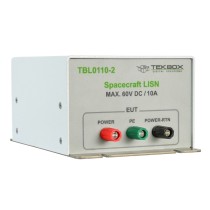
Tekbox TBL0510-1 LISN
Details
Every electronic device that comes onto the market must comply with certain 'EMC guidelines'. These guidelines refer to the extent to which the device to be tested interferes electromagnetically with other devices. A Line Impedance Stabilisation Network (LISN) is a device that is used, in conjunction with a measurement receiver or spectrum analyser, to measure the interference on a power line. As the name implies a LISN to provide a stabilised fixed measurement impedance regardless of the impedance of the current source.
The TBL0510-1 is a 5µH LISN that can be used to measure the conducted noise on the feed line of DC-powered devices. This LISN is designed to perform EMC pre-compliance testing in the frequency range from 10kHz to 400MHz. Moreover, this LISN comes with a grounding plate. The TBL0510-1 is connected with two DC connections between the power source and the device under test. The conducted noise is coupled from the power line to the 50Ω BNC terminal with minimal losses, where the interference can be analysed. With, for example, a spectrum analyser. Furthermore, the LISN isolates the device to be tested and the BNC terminal from the noise. which is caused by the power source. The source connection and the device connection are disconnected by an inductor of 5μH.
For more information on measuring with TBL0510-1 and EMC directives, please consult the PDFs at the bottom of this page. Further, there is also PC software to further analyse EMC measurements. This software, EMCview, can be found here.
Watch out! This LISN is suitable for EMC testing on DC-powered devices. For testing on single-phase AC-powered devices, you can use the TBL5008-2C.
Specifications
| Frequency range | 10 kHz – 400 MHz |
| DC resistance | 40 mΩ |
| Max current | 10 A |
| Nominal voltage range | 0 – 60 VDC |
| Max. voltage | 200 VDC |
Downloads
| Tekbox TBL0510-1 user manual |  (1.43 MB) (1.43 MB) | Download |
Similar products