
Most of the electronics produced worldwide are soldered with convection ovens. These ovens are also available for laboratories or small series productions. However, they are not very user-friendly. That is why are a good alternative.
Conventional reflow ovens melt the soldering paste on the PCB by heating the air, or by directly heating the electronics. However, there are some disadvantages to this:
- In order to heat the soldering paste, the radiant heat needs to pass through the component to be soldered. This causes enormous heating of the component.
- Some components are more sensitive to radiant heat than others. For example, a header may melt in the oven while the soldering paste under a BGA chip hasn’t melted yet.
- The set temperature needs to be much higher than the melting temperature of the soldering paste. Otherwise, this will increase the risk of overheating.
- To prevent overheating, it is best to use the lowest possible temperature, but this can result in the tin not melting properly.
These problems are particularly common in small soldering ovens that are often used in laboratories or for small series. A good example of such an oven is the T962A. It takes practice to get good results with this oven and even then consistent results are not always guaranteed. Vapour phase is a very good alternative for these types of ovens.
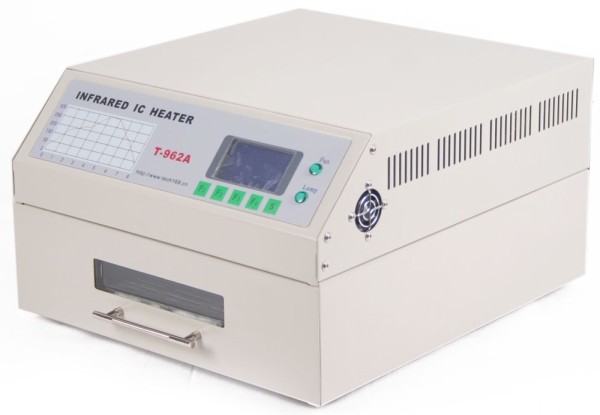
The T962A soldering oven heats with radiant heat.
How does vapour phase soldering work?
Vapour phase soldering immerses the electronics to be soldered in a hot vapour. The hot vapour transfers the heat to the soldering tin, which melts as a result. Because hot vapour has a 10 to 100 times better heat transfer, soldering can be done at a lower temperature.
In addition, the vapour displaces all the air around the electronics and so all components will be soldered.
Vapour has a fixed temperature, namely the boiling temperature, which offers significant advantages. The temperature of the vapour will never be higher than this temperature. As a result, components will never overheat.
Compared to reflow ovens, vapour phase offers better heat transfer, a uniform temperature, overheating is excluded, there are less unsoldered parts and components are less stressed due to the lower temperature. Overall, vapour phase will lead to better and more consistent soldering results.

During convection soldering, the heat has to pass through the component in order to heat the tin and the component will be heavily stressed as a result.

During vapour phase soldering, the vapour comes in direct contact with the soldering tin, even directly under the components.
The vapour phase process
There are several vapour phase processes. The heat level adjustment process is the most basic one. This is also the process used in the vapour phase oven we sell, so we will elaborate this process here.
Step 1: The start-up phase
The vapour phase machine consists of a container that contains the soldering fluid. A few centimetres above the liquid, the PCB is placed with the soldering paste and components, and the container is then closed. During this stage, the liquid is still cold and no soldering vapour occurs. At the bottom of the container, heating and cooling elements are present to regulate the temperature of the liquid.
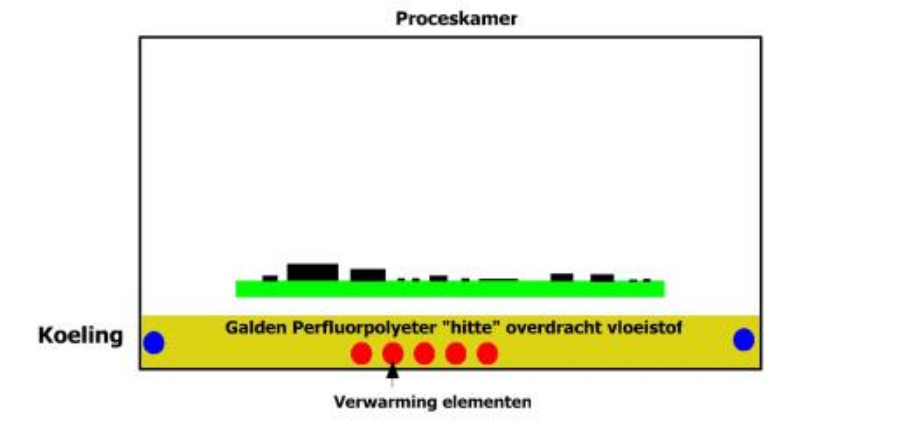
The start-up phase
Step 2: The active phase
During the active phase, the liquid is heated and will thus boil and evaporate. This vapour rises and drives the air upwards. This will cause the vapour to enclose the PCB entirely as shown in the picture above. The vapour will touch the PCB and because the PCB is colder than the vapour, the vapour will condense onto the PCB. Because of this, a heat transfer will take place.

The active phase
Step 3: Cooling down
The active phase ends when the PCB has the same temperature as the vapour. This causes the vapour to rise further upwards. When this happens, the heating will switch off and the cooling will switch on. The vapour will sink again and the PCB will cool down. When everything is cooled sufficiently, the container can be opened and the PCB can be removed from the container via the top.
The vapour phase liquid
During vapour phase soldering, a liquid is evaporated. The vapour of this liquid cannot react with the materials in the electronics and needs to have a boiling temperature that is higher than the melting temperature of soldering tin. Solvay developed a liquid specifically for vapour phase soldering, called Galden. This liquid is available in a variety of boiling temperatures. For soldering with lead-free paste, Galden LS-230, with a boiling temperature of 230°C works best.
Galden’s fundamental properties for vapour phase soldering are:
- The liquid is inert and therefore does not react with other materials.
- It’s environmentally friendly and non-toxic.
- The liquid does not conduct electricity.
- Galden is inflammable.
- Galden provides excellent heat transfer.
Solvay patented the formula for Galden and know its value for phase soldering, so the liquid is pricey. Fortunately, only a small amount is needed to solder and is used up each time.
The vapour phase soldering oven
For vapour phase soldering, an "oven" is required that regulates the vapour phase process. For this purpose, we recommend the Vaporflow 275 vapour phase oven. This is a vapour phase oven that works according to the "heat level adjustment" process described above. The oven can accommodate PCBs with a surface area of up to 235 x 170 mm.

Vaporflow 275 vapour phase oven
The Galden is poured into the bottom of the oven and does not need to be removed again. The PCB to be soldered is placed a few centimetres above the Galden on a plateau. Once the PCB is put in place, the oven can be closed with a lid and the soldering process can be started with the push of a button. The whole process takes about 10 minutes, after which the PCB can be removed from the oven.
Because the lid does not close off the oven 100% airtight (this is not possible because of pressure build-up), a small amount of Galden will leak out. This amount is minimal and will cause little loss per soldering cycle.
In addition to heating and cooling the Galden and the process control, the oven also provides the necessary safety measures. It is key that the Galden never gets warmer than 295 °C because then toxic fumes are released. The oven is equipped with a safety sensor to prevent this from happening.
You can even solder double-sided SMD with the vapour phase soldering oven. First, solder the bottom side of the PCB with small components and then the side with the large components. Due to the surface tension of the soldering tin, the small components at the bottom will stick to the PCB during the soldering of the topside.
Conclusion
Vapour phase soldering is perfect for soldering small batches of SMD components. The soldering process is more straightforward, the results are better and more consistent compared to a small convection oven.
The Vaporflow soldering oven is a good example of an affordable vapour phase oven that is ideal for use in laboratories, educational institutions and small businesses where relatively small batches are soldered. Virtually nothing needs to be preset and the process controller of the oven ensures proper completion of the vapour phase process.
If you have any questions about vapour phase soldering, or if you have an experience you would like to share, please leave a comment below.





